Know next year's revenue from the diagnoses CMS has already accepted.
A plan's own claims say what it submitted. The MAO-004 says what CMS accepted for risk adjustment, record by record, with the reason when it did not. Vernier reads that report every month, scores every member with CMS's own 2027 model tables, and projects payment-year revenue a finance committee can take apart member by member.
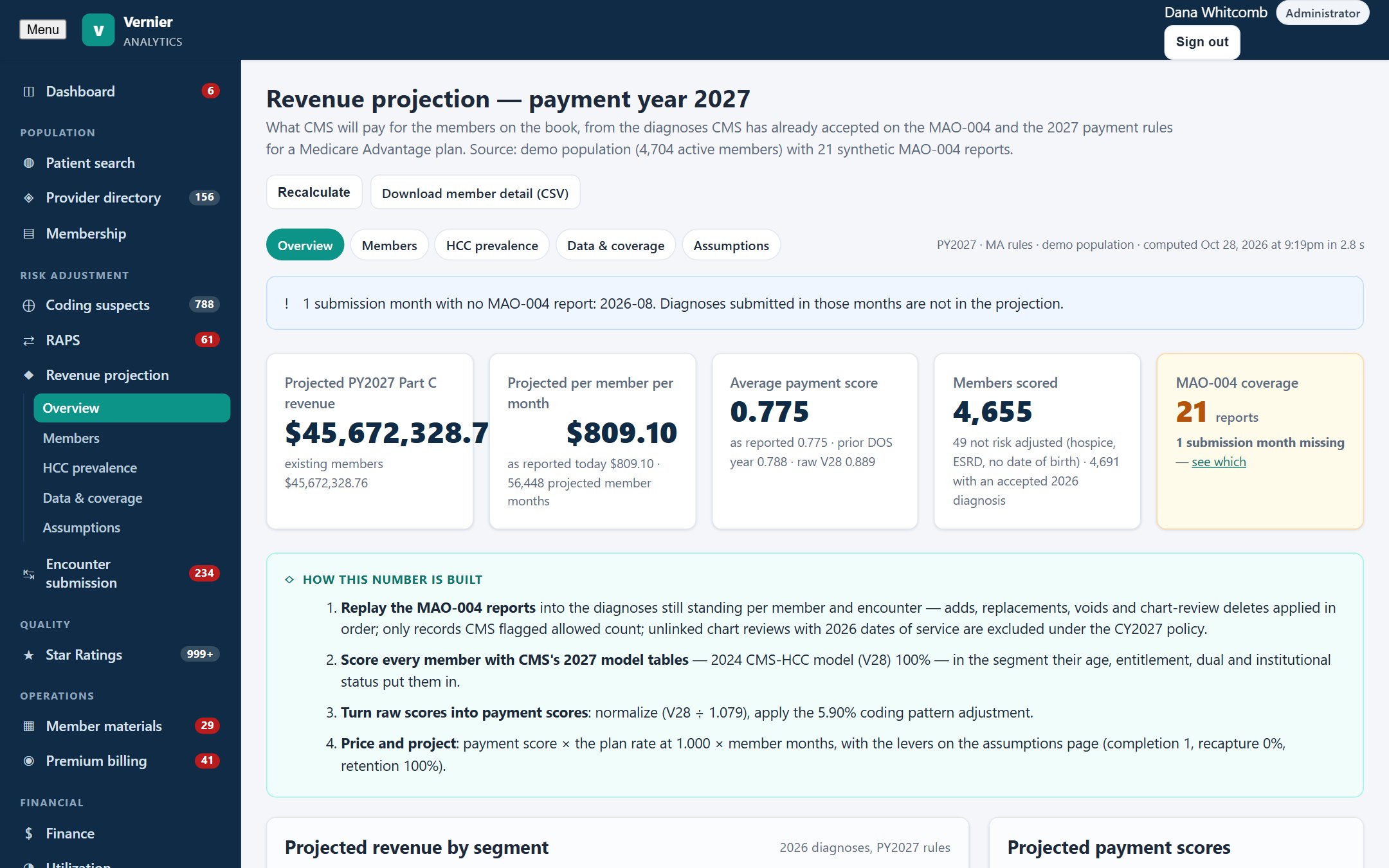
Project from the number CMS has agreed to.
Most revenue forecasts start from an internal RAF estimate and a growth factor. Vernier starts from the Encounter Data Diagnosis Eligible for Risk Adjustment report, the MAO-004, which CMS sends every month and which lists, per encounter and per diagnosis, whether it was allowed for risk adjustment.
Monthly deltas become the diagnoses still standing
The MAO-004 is a change file: adds, replacements, voids and chart-review deletes referencing earlier records. Vernier replays the reports in order and keeps, per member and encounter, exactly the set CMS will run through the model.
The 2027 model software, not an approximation
Diagnosis-to-HCC mappings with their age and sex edits, hierarchies, disease interactions and the HCC-count variables, from CMS's 2027 release. The 2024 CMS-HCC model for Medicare Advantage; the 2024 and 2017 models blended for PACE.
A budget that moves with the data
Each new report re-runs the projection. A month with no report is flagged as missing, because a quiet month on the MAO-004 is the most common reason a projection reads low.
The arithmetic CMS uses, on your members.
Raw scores are normalized with the CY2027 factors, reduced by the coding pattern adjustment, given the frailty score where it applies, and priced: the plan's standardized rate for Medicare Advantage, or the county rate from CMS's 2027 PACE rate book. Member months, retention, new enrollment, diagnosis completion and recapture are the levers a finance team sets, and every run records which values it used.
- Nine model segments: community by dual and entitlement status, long-term institutional, new enrollee and C-SNP new enrollee.
- Prior-year HCCs not yet documented this year shown per member, so recapture is a list of names, not a factor.
- Sensitivity on the headline, and a member-level CSV of every score, HCC and dollar.
Five views, one projection.
The CY2027 rules, applied as CMS writes them.
Medicare Advantage plans and PACE organizations are paid under different rules. Vernier applies the right set for the organization, and the assumptions page shows which one is in force.
| Rule | Medicare Advantage | PACE |
|---|---|---|
| Model | 2024 CMS-HCC (V28), 100% | 50% 2024 model + 50% 2017 model (V22) |
| Normalization | 1.079 | 1.079 and 1.202, per model |
| Coding adjustment | 5.90% | 5.90% |
| Frailty | Not applied | Plan frailty score, community enrollees |
| Rate | Plan standardized rate at 1.000 | CMS 2027 county rate |
| Unlinked chart reviews, 2026 DOS | Excluded | Counted |
Checked against CMS's own software before a prospect sees it.
The scoring engine reproduces CMS's published 2027 model software score for score across all nine segments, with and without the MCE edits. The engine that ships inside the portal is held to that reference by an automated comparison of 10,229 values: 700 beneficiaries scored by both models, twenty-one monthly MAO-004 reports parsed and replayed under both the MA and PACE policies, and three complete projections down to each member's dollars. The tables themselves are CMS's files, unmodified.
The same member, everywhere
The risk score on a member's Patient 360 header is the model's raw score of the diagnoses an encounter this year carries. The projection scores the same diagnoses from the MAO-004. They agree, and when they do not the data and coverage page says why.
What is not counted is listed
Superseded, voided and disallowed records are kept and explained, never silently dropped. A diagnosis CMS turned down with reason H or D is visible on the member who carried it.
What is not modelled is stated
Part D (RxHCC) and the ESRD model are not projected; ESRD enrollees carry an assumed score against the ESRD rate, and the page says so. Hospice months are not risk adjusted and are shown as such.
The other half: what the chart supports.
The projection says what CMS has accepted. Chart review reads the clinical note and says what the record supports: the conditions a note documents that have not been submitted, and the accepted diagnoses that no signed note backs up. Every finding shows the passage it came from, and a coder decides each one.
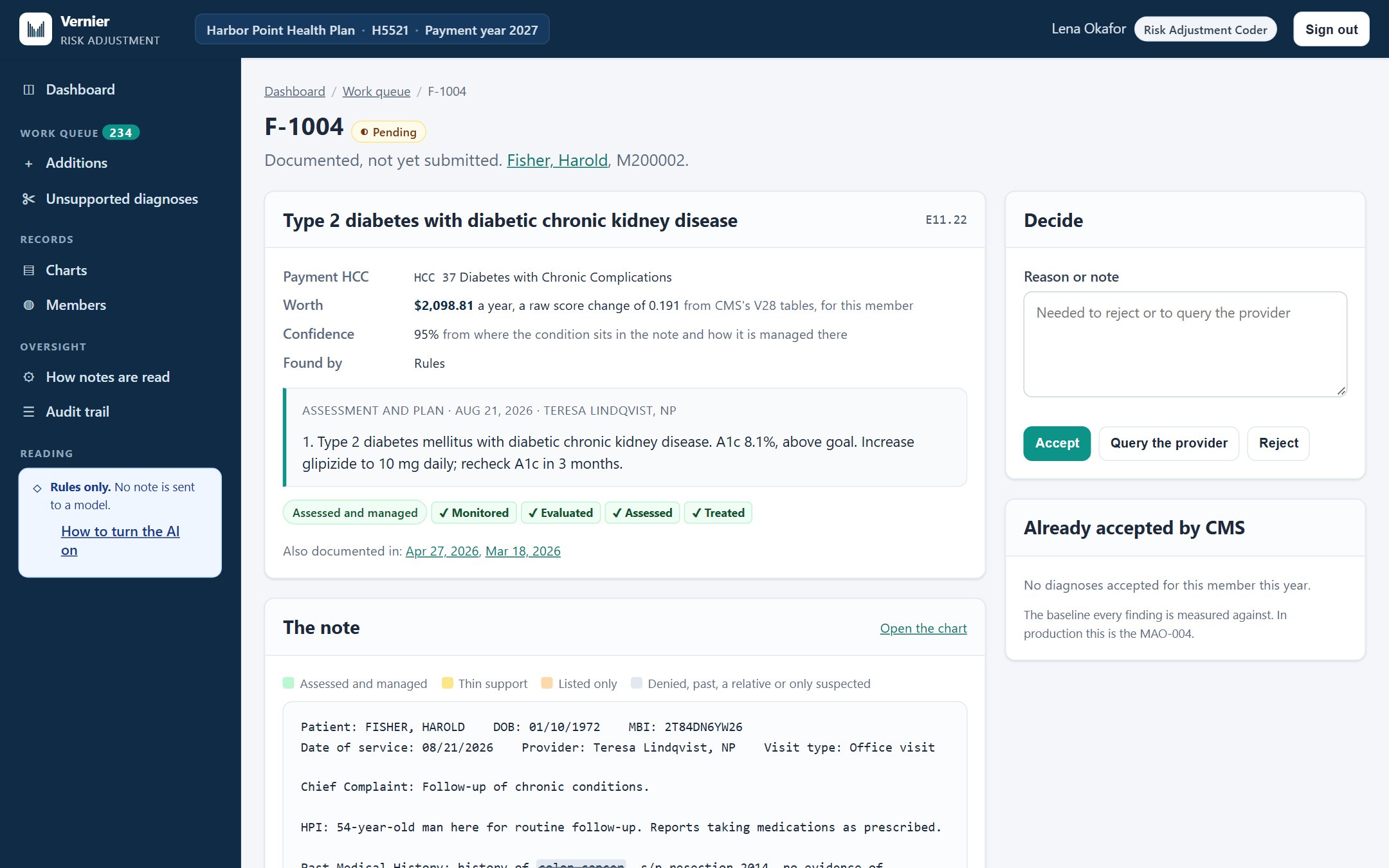
Present, or only mentioned
Finding the word is the easy part. "No evidence of heart failure", "mother had breast cancer", "history of DVT, resolved" and "possible early dementia" each name a condition and none documents one. Each is marked in the note and set aside with the reason. A condition that appears only in a problem list cannot be accepted on that alone.
Diagnoses to add, and diagnoses to withdraw
The same notes are read the other way. An accepted diagnosis that no signed note documents is raised as unsupported and valued at what the plan would repay. It gets the same space on the screen as the additions, because a tool that only finds things to add is one an auditor will not trust.
What each finding is worth to that member
Every finding is mapped and valued with the same 2027 model tables as the projection, for the member it belongs to: nothing if a more severe condition already outranks it, more than its own factor if it completes an interaction. The work list is ordered by confidence, never by dollars.
Built to be audited
- Nothing can be accepted from a note that is unsigned, undated or not a face-to-face visit.
- A condition that is only listed goes to a provider query, tracked as its own status.
- Rejecting a finding needs a reason, and how often coders agree with the software is reported.
- It produces two lists, additions to submit and deletes to withdraw. It sends nothing to CMS.
- The dashboard totals the two lists side by side, and each member's page shows their condition categories and score with the coder's decisions applied.
- Every chart loaded, every decision and every export is in the audit trail, with who did it.
Not yet
- PDF files, scanned and faxed pages, and handwriting. Today it reads typed notes.
- A direct feed of notes from the EHR. Today notes are loaded one at a time.
- An AI reader for conditions the written rules do not recognise. It is built so that a proposal is discarded unless its quote is in the note word for word and its code is one CMS's table knows, and it has not yet been validated on real notes. It is off by default, and while it is off no note leaves the plan's server.