Population-health intelligence for Medicare Advantage, built by someone who has run the plan you run.
Vernier covers the payer, the provider, the member, the agent, credentialing, risk adjustment and the CMS interoperability mandate. Not a dashboard layer: twelve applications, each demonstrable on screen, designed by an operator who has stood up five Medicare Advantage plans and five ACOs.
Everything a risk-bearing organization needs to see, in one contract.
Vernier is read-and-decide across the whole plan. It is built to read your adjudicated claims feed, surface the exception and the owner, and leave the transaction in the core system you already own. Today the applications run on demonstration data, and the revenue projection loads a plan's own MAO-004 reports and membership file.
Analytics Portal
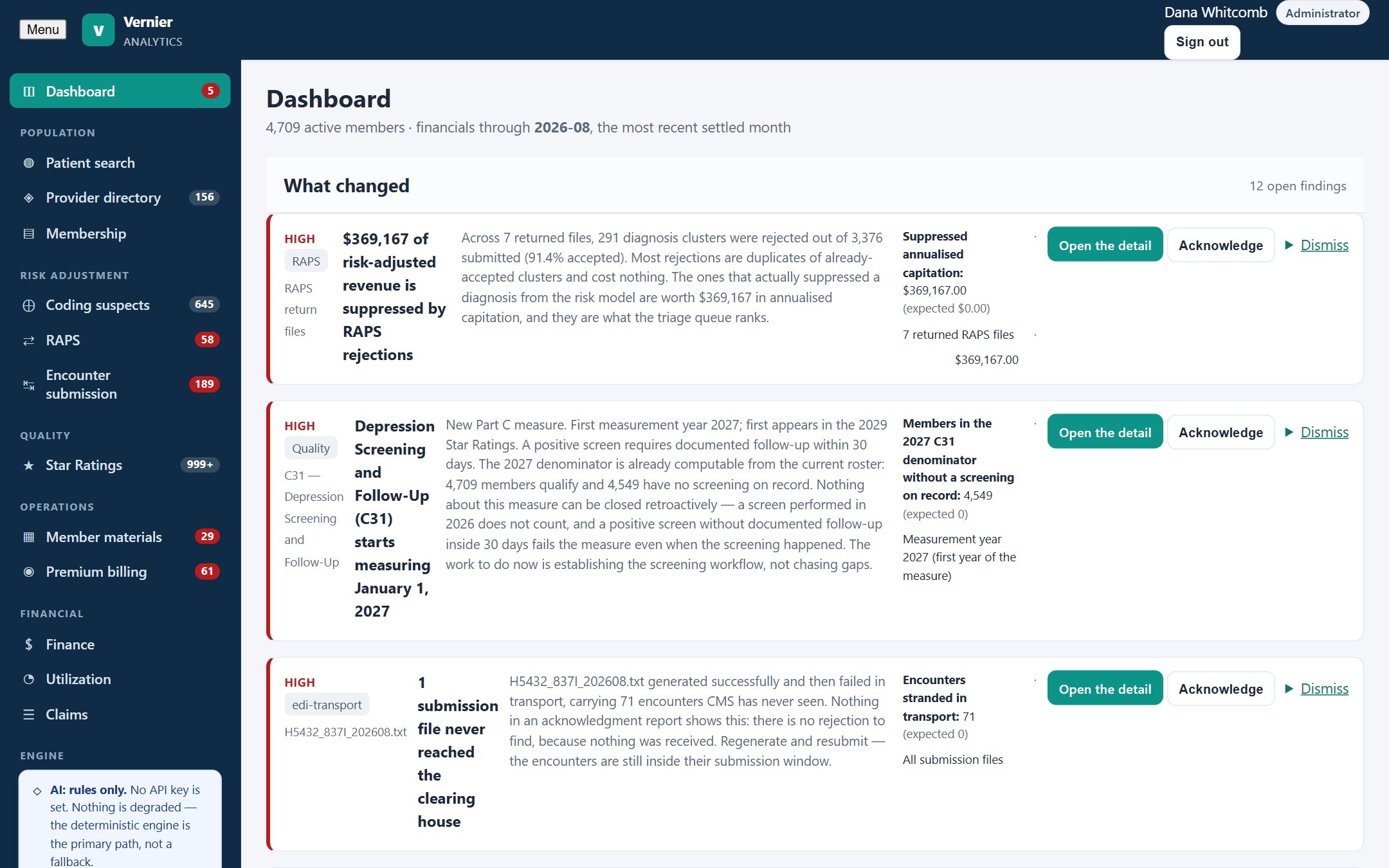
Fifteen modules: Patient 360, coding suspects, RAPS triage, the payment-year revenue projection from the MAO-004, Star Ratings, MLR, utilization, membership and churn, claims, encounter submission, member materials, premium billing.
Explore analytics → CMS-0057-FInteroperability
Patient Access, Provider Access, Payer-to-Payer and Prior Authorization APIs on FHIR R4, with the seven-day decision clock carried on every request.
Explore the FHIR APIs → Plan operationsAdmin Portal
Enrollment lifecycle, agent approval, scope-of-appointment compliance, authorizations, correspondence, workflow and a data-health layer that keeps every queue in view.
Explore admin → NetworkProvider Portal
Eligibility, prior authorization, a claims worklist with denial resolution, remittances, and evidence-backed coding and care-gap worklists, scoped to the practice's own panel.
Explore provider → MemberMember Portal
Coverage, ID card, claims, prescriptions and labs with plain-language explanations in English and Spanish, guided appeals, secure messaging and a consent center.
Explore member → OutreachCRM
One activity log for calls, notes, tasks, email and physical mail, with document upload and six standard reports.
Explore CRM → NCQACredentialing
Practitioner and facility credentialing on a guarded state machine with an immutable audit trail and automated primary-source verification.
Explore credentialing → AssessmentVernier HRA
Adaptive health risk assessment with fourteen condition modules, validated screener escalation, nurse review and sign-off, and a living document per member.
Explore HRA → Care managementCare Management
A care plan for each member from diagnoses, claims and pharmacy fills: disease states, a six-month hospitalization risk tier with its drivers, and actions a care manager accepts or dismisses, each tied to the record behind it.
Explore care management → FinanceRevenue Cycle
CMS payment reconciliation: reads the MMR, the TRR and the Model Output Report, prices every member-month, and turns each difference into a case with a cause and an owner.
Explore revenue cycle → Risk adjustmentChart Review
Reads the clinical note, shows the passage behind every finding, and keeps two work lists: diagnoses to add, and accepted diagnoses no signed note supports.
Explore chart review → ACO qualityQuality Reporting
The two clinical measures an ACO submits itself, for the LEAD Model and MSSP APP Plus: matched to the EHR, computed clause by clause, with data completeness tracked against the 75% floor by practice.
Explore quality reporting →Five Medicare Advantage plans. Five ACOs. Thirty-five years.
Bruce Romanello designed, launched and ran five CMS-approved Medicare Advantage plans across Florida, South Carolina and Georgia, established one of the nation's first Shared Savings ACOs in 2011 and four more after it, and owned one of the largest Humana-affiliated MSOs in Florida.
Vernier is the platform he kept asking vendors to build: one that keeps every queue measured, says what is not built, and puts the number where it cannot be walked past.
One member, followed through four applications.
In a demonstration, one member is followed through four applications and the numbers agree at every step. The member portal, the provider portal, the analytics portal and the FHIR service are loaded with the same people, with the same IDs, claims and providers. Each application keeps its own database and sign-in today; shared sign-on is on the roadmap.
Member Portal
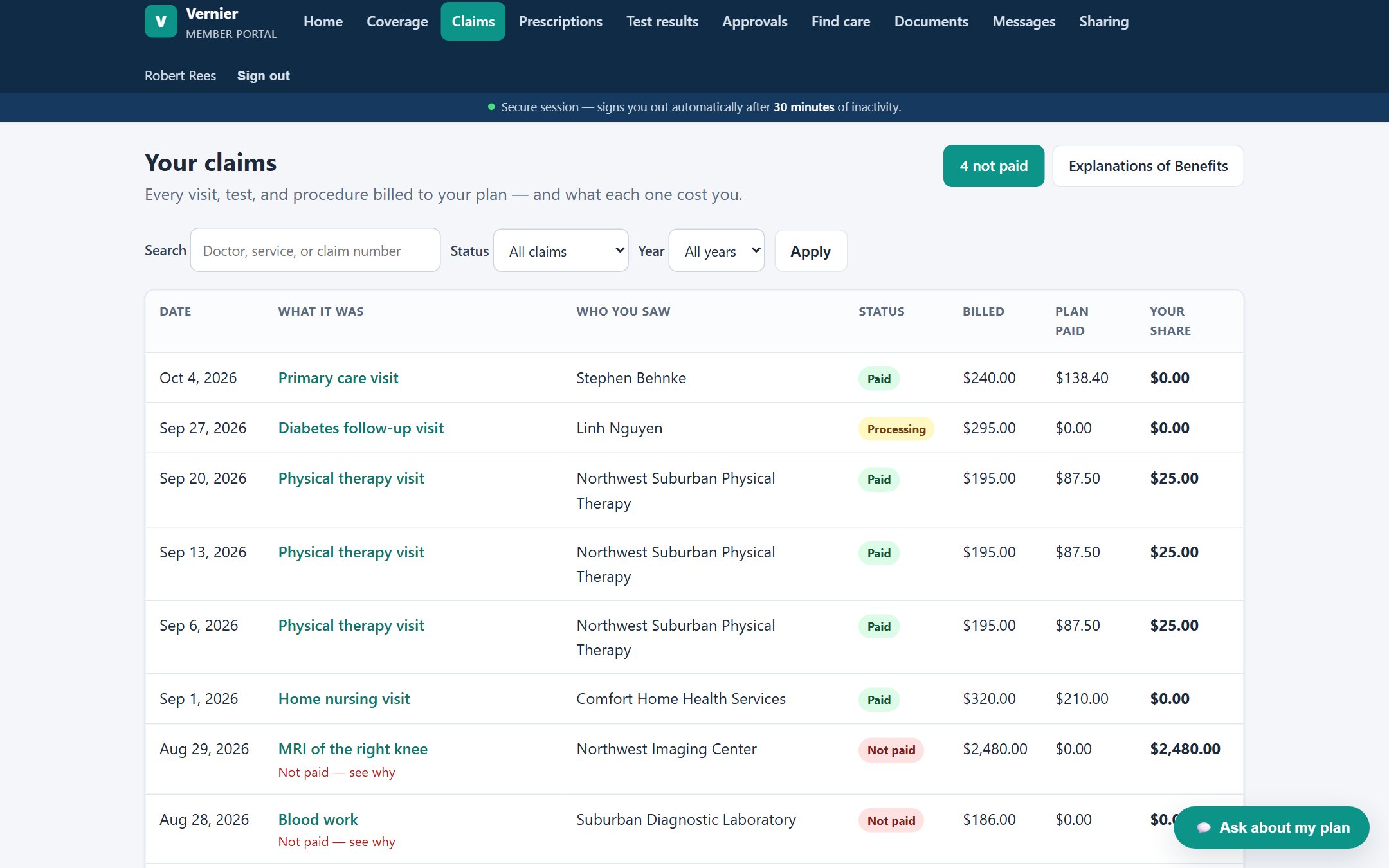
The member signs in, sees coverage, the ID card, claims and prescriptions, and a denial explained in plain language.
Provider Portal
The same member appears on the practice's attributed panel with the same claims, coding suspects and open care gaps.
Analytics Portal
The plan sees the member in Patient 360, the Star measures, the claims detail that sums to the header, and the revenue projection that scores the same diagnoses with CMS's own model tables.
FHIR API
A Patient Access request returns the same person as FHIR resources, with provenance marking every record as claims-derived.
The demo population is deterministic: the same seed produces the same numbers in front of every prospect, and an automated suite checks that header totals equal the sum of their detail rows, that every coding suspect cites a record that exists, and that every NPI passes the check digit.
The deadline has a date and an owner.
Four FHIR APIs in production
Patient Access, Provider Access, Payer-to-Payer and Prior Authorization. Vernier implements all four against FHIR R4, US Core 6.1.0, CARIN Blue Button 2.0 and Da Vinci PDex and PAS, with 42 automated conformance assertions passing.
Standard prior-auth decisions move from 14 days to 7
The half of the rule that reorganizes a utilization-management department. Vernier shows the queue of authorizations that will breach the clock this week, and who owns each one.
Your prior-authorization numbers become public
The rule requires annual posting of prior-authorization statistics. Vernier publishes the disclosure from the same data the queue runs on, so you know what the numbers say before anyone else does.
Next year's revenue from this year's MAO-004
CMS's 2027 model tables, the CY2027 normalization and coding adjustment, PACE blend and frailty, county rates. Every member's score and dollars, rebuilt each month as the reports arrive. Revenue projection →
Every AI feature has a rules path that always runs.
Vernier's AI rewrites output. It does not make determinations. Every explanation, triage and draft is computed first by deterministic rules from the member's own records. A language model, when configured, rewrites the prose. There are two stated exceptions. In chart review a model may propose a finding the rules missed, and code checks that proposal against the note before a coder decides it. In care management a model may propose additions to a care plan, and code checks each one against the member's record before a care manager decides it. No AI call runs on a page render, so the platform is fully functional, and fully demonstrable, with no model key at all.
- Coverage decisions, agent rejections and eligibility denials require a human action.
- Member-facing AI is scoped to the authenticated member's record by construction.
- Every AI suggestion and the human action taken on it is logged.
Value-based, at-risk organizations.
Startup and small MA plans
2,000 to 25,000 members. The whole stack, with next year's revenue projected from your MAO-004, at a price shaped for a plan that cannot afford an enterprise vendor.
PACE organizations
Small census, high touch. A revenue projection that knows the PACE rules, care management, HRA and outreach, with the FHIR mandate that does not apply to you left off the pitch.
IPAs, MSOs and ACOs
The provider portal, risk adjustment and population analytics for organizations that own attribution and feel provider abrasion directly.
Twenty minutes. No deck.
Bring your current system list. Bruce will open the applications, trace one member across them, and show you what January 1, 2027 looks like when it is handled.